You found the perfect Amsterdam apartment: canal view, charmingly terrifying staircase, and — wait — no washing machine. Not even a hookup. Welcome to one of the city's classic housing surprises, and one that catches out expats, students and long-stay visitors every single week.
The good news: Amsterdam has quietly built an entire ecosystem around this problem, from old-school wasserettes to full pickup-and-delivery apps. This guide walks through every realistic option, what each actually costs, the Dutch words you'll need, and one genuinely pleasant surprise about Amsterdam's tap water. (Transparency up front: this guide is published by eazyy, a laundry pickup app. We identify our own service below and explain when a self-service option may cost less.)
Why so many Amsterdam flats have no washing machine
It's not you — it's the buildings. A huge share of Amsterdam's housing stock dates from the 17th to early 20th century: narrow canal houses and pre-war apartments that were subdivided into flats long after they were built. Many simply have no sensible spot for a washing machine — no drain connection in the right place, wooden floors that owners' associations (VvE) would rather not soak, and kitchens the size of a generous cupboard.
Add two Dutch rental quirks. First, unfurnished rentals here are often really unfurnished — "kaal" (bare) lettings can come without appliances, curtains or even flooring, so previous tenants take the machine with them. Second, student housing and short-stay apartments frequently rely on shared laundry rooms, or skip machines entirely.
Moving into a student room? Ask the landlord or housing provider whether a washing machine is included or shared, how payment works and when the laundry room is open. For the wider accommodation search, StudyPath’s student housing guide explains common room types and housing platforms. StudyPath also includes Eazyy in its Netherlands apps guide.
The result: laundromat culture never died in Amsterdam the way it did in some cities. There's almost certainly a wasserette within cycling distance of you right now — and several services that will come to your door instead.
Your 4 options, honestly compared
1. A shared or in-house machine (cheapest per load)
If your building has a shared laundry room — common in student complexes and newer developments — use it. At roughly €1–3 per wash it's by far the cheapest option. Check your rental contract before buying your own machine: some landlords and VvEs prohibit installation, especially in older buildings. If you can install one, a basic machine runs €300–500 new. Fair warning: Dutch apartments rarely have room for a dryer, which is why every household here owns a drying rack (droogrek). It's a lifestyle.
2. The wasserette (laundromat) — the DIY classic
How it works: bring your laundry and detergent (or buy a single dose there), load a machine, pay at the machine or a central terminal — most take cards now, though some older spots still run on coins (muntjes). A wash takes 30–45 minutes; dryers charge by time.
Typical Amsterdam prices: expect roughly €7–13 for a standard wash (bigger 10–16 kg machines for duvets cost more, often €10–14), and €1–2 per 10–15 minutes of drying. A full load washed and dried usually lands around €9–15. Most wasserettes open early and close late; a few are self-service around the clock. Best use case: you have time, you're on a budget, or you need to wash something huge like a duvet (dekbed).
3. The service wash (drop-off) — the quiet middle ground
Many wasserettes offer a service wash: drop your bag off, they wash, dry and fold it, you collect it later that day or the next. Expect around €10–20 per load depending on weight. You still do the carrying, but not the sitting-around. If there's a good wasserette on your route to work, this is a genuinely great option and we'd be lying if we said otherwise.
4. Laundry pickup apps — the door-to-door option
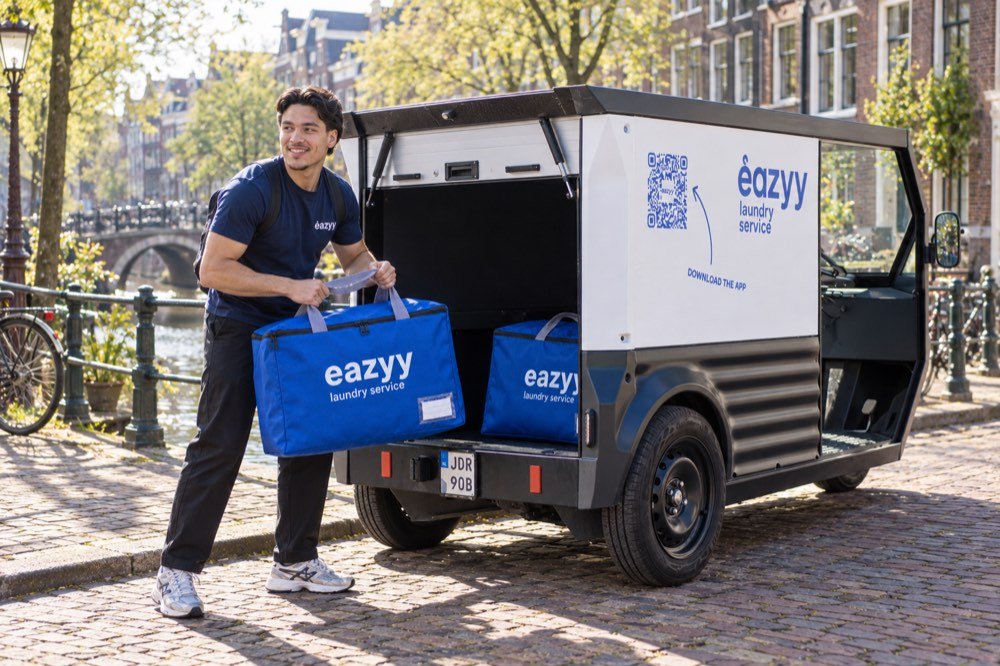
Several services in Amsterdam collect your laundry and bring it back clean. Full disclosure: eazyy is ours, and this guide lives on our site. Our laundry pickup and delivery service starts at €23 for a 6 kg mixed-wash bag, including washing, drying, folding, collection and return. Bags run up to 20 kg; separated washing costs €7 extra per bag. The eazyy Bag returns within 24 hours, except Saturday pickups, which return Monday. Collection and delivery run Monday–Saturday, 08:00–22:00. Check your address before booking. Ironing and dry cleaning are separate services with per-item prices shown in the booking catalogue. Dry cleaning usually takes 2–3 working days, with some delicate items taking longer. Self-service may cost less; pickup saves you carrying the laundry and waiting at the machines.
Dutch laundry words: a mini cheat-sheet
Laundry is one of those errands where Dutch signage gets very specific very fast. The essentials:
| Dutch | English |
|---|---|
| wasserette | laundromat |
| stomerij | dry cleaner |
| wasmachine / droger | washing machine / dryer |
| wasmiddel | laundry detergent |
| wasverzachter | fabric softener |
| bleek / bleekmiddel | bleach |
| witte was / bonte was | whites / colours |
| fijne was | delicates |
| strijken | ironing |
| wassen en vouwen | wash & fold |
| dekbed | duvet |
| muntjes | coins / tokens |
| ophaalservice | pickup service |
Two that trip people up: a wasserette washes regular laundry, while a stomerij is a dry cleaner for suits, coats and delicate fabrics — walking into a stomerij with a bag of gym clothes will earn you a polite Dutch eyebrow. And wasverzachter (softener) is not detergent; grabbing the wrong bottle at Albert Heijn is a rite of passage.
Decoding Dutch care labels (the 30-second version)
Before you wash anything — especially in an unfamiliar machine — check the care label. The short version: the number in the tub symbol is the maximum wash temperature, a hand in the tub means hand-wash only, a triangle covers bleach, the square is drying, the iron is (surprise) ironing, and a circle means professional cleaning — that one goes to the stomerij, not the wasserette. A crossed-out symbol means don't.
There are about 20 symbols worth recognising, and we've broken down every one of them in our full guide to Dutch washing symbols. Bookmark it for the next time a label tries to communicate exclusively in hieroglyphics.
One nice surprise: Amsterdam's water is soft
Here's a small win for your laundry (and your kettle). According to Waternet, Amsterdam's water supplier, the city's tap water has a hardness of 7.8 °dH (1.40 mmol/l) — officially classified as soft, since 8–12 °dH counts as average and only above 12 °dH is water considered hard.
What that means in practice: use less detergent than you think. Detergent packaging lists doses per water hardness — follow the "soft/zacht" column, which is usually the smallest amount. Overdosing in soft water doesn't get clothes cleaner; it leaves residue, makes fabrics stiff, and can cause extra suds. Waternet also confirms you don't need a water softener for your washing machine here, and soft water means less limescale wear on the machine itself. If you've moved from a hard-water city like London, your towels are about to have a better life.
Sources
FAQ
How much does a laundromat (wasserette) cost in Amsterdam?
Expect roughly €7–13 for a standard self-service wash and €1–2 per 10–15 minutes of drying, so a full load washed and dried usually comes to €9–15. Large machines for duvets cost more (often €10–14), and a drop-off service wash typically runs €10–20 per load. Prices vary by neighborhood, so check the board at your local wasserette.
What's the difference between a wasserette and a stomerij?
A wasserette is a laundromat for everyday washing — clothes, bedding, towels. A stomerij is a dry cleaner, for suits, coats, silk, wool and anything whose care label shows a circle symbol. Some shops do both, but they're different services with different prices, so check the sign before you walk in with the wrong bag.
Can I do laundry on Sunday in Amsterdam?
Yes. Unlike some things in the Netherlands, laundry doesn't take Sundays off: many wasserettes open seven days a week, some self-service locations run extended or round-the-clock hours, and pickup services operate on Saturdays too (eazyy runs Monday through Saturday, 08:00–22:00). Sunday morning is often the quietest time to claim a machine.
I'm only in Amsterdam for a week — what's the easiest option for tourists?
A nearby service wash or laundry pickup can save carrying and waiting. With eazyy, check your accommodation address and choose a return slot before checkout. The eazyy Bag returns within 24 hours; Saturday pickups return Monday. Arrange any reception hand-off with your accommodation. Dry cleaning has a different turnaround, usually 2–3 working days.